- HubPages»
- Education and Science»
- History & Archaeology»
- Ancient History»
- Dead Languages
European Origin of Sanskrit Language

Sanskrit is Alien to India
Sanskrit Pundits and Sanskrit lovers like to find similarities in words of European languages and that of Sanskrit. This way they are supporting the theory that Sanskrit has its roots in Europe.
There are many words in Sanskrit which are similar to Latin, Russian, Greek, English and other European language. We can find Similarities in pronunciation and similarity in meanings. One of the great examples is the Word 'Maatru' for Mother in English, Mater in Latin, Mere in French, Mutter in German and Madre in Spanish.On the other hand the Sanskrit word for Father is Pitru/ Pitar. The European equivalents for this word are Pater in Latin, Father in English, Padre in Spanish, Vater (pronounced Fater) in German. These two words are the basic and ancient words as the child learns it as his first and second word to speak and they are being used for thousands of years.
Now if you see what words are used for Matru and Pitru in Indian languages, you will be surprised to know that there are no sound similarities in the words with these Sanskrit words.
Here is the list of words for Matru in major Hindian langauges: Tamil: Amma, Kannada: Aau, Marathi: Aai, Gujarati: Baa, Rajasthani: Baai, Urdu: Ammi, Magadhi: Amba etc. In Hindi the word for mother is Maa, but as this language is most Sanskritized language, we should find the original equivalent which is Amba.
The equivalent words for Pitru in Indian languages are:Bapp in Magadhi. Aappa in Tamil, Baap in Hindi, Aappa/ Baapa in Kannada, Baaba in Marathi, Baapu in Gujarati and Abba/ Baba in Urdu.
Thus we find that there are no similarities between Sanskrit and other Indian languages in these two most important words. At the same time we find similarities between Sanskrit and European languages in case of these two words.
There are lot of other words in Sanskrit which have similarities with the words of European languages.
Other Similarities
1. A great similarity between Sanskrit and some European languages is the use of Dual Number. In Sanskrit, it is called as Dvi Vachan. In ancient Latin and Greek languages dual numbers were used and languages of Slavic group till use this form. But no Indian language use this form.
2. In Sanskrit language, there is a high number of compound letters having letter R in it. i.e. BRahmin, Kram, KaRM, NaMR, AyuRVed, KRut, KRiya, KRipa, rashTRa and so on. In European languages also we see high number of compound letters having letter R in it. But on other hand, you will not find compound letters having R in it in original words of Indian languages.
3. Further, there are lot of words with compound letters DRa and TRa. like InDRa, miTRa, shaTRu, TRi, PuTR, shuDRa etc. Such compound letters are also found in Russian language. In Russian language TSa is a compound letter, we find it in Sanskrit also. But in Indian languages you will not find such compound letters in original words.
4. One of the distinctive feature in compound letters in Indian languages is that there are lot of words having compound letters containing same letter for two times, or having letters of same group i.e. Buddha, Khatta, Dilli, Mudda, Chhutta, Abba, Ammi etc. Sanskrit and European languages lack of such compound words.
5. DV is another common compound letter found in Russian and Sanskrit languages.
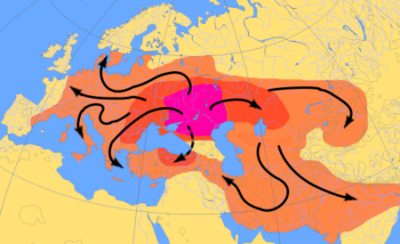
All these facts clearly indicate that Sanskrit is closer to European languages, not to Indian languages. Why it is so? The answer is easy. Sanskirt was language of the Aryans who came to India from Eastern parts of Europe. There language was the same which was spoken in that part of world. When they came to India, it was changed due to the influence of indigenous languages of India.
-Mahavir Sanglikar
Related Hubs
- Sanskrit Language Facts
This article reveals many facts about Sanskrit language. Although the Sanskrit lovers think that it was a popular language in ancient India, it was never spoken by common people - Is Sanskrit The Language of Gods?
Sanskrit lovers say that Sanskrit is the language of Gods, and so it is eternal, i.e. it exists from beginning of the universe. But is the language God's own language? And does it exist from the time immemorial? - What The Great Scholars Said About Sanskrit Language...
Great scholar of Indology, linguistic and history have written their bold opinions about Sanskrit language in their scholarly works. Here are some of the quotes by by them regarding Sanskrit Language. - Sanskrit: a Language Without Script
If we look at the history of Sanskrit, one thing we clearly notice that Sanskritists avoided to use it in written form, and for centuries, it was just an oral language. The method of transforming the literature was to memorize, recite and handover to - Sanskrit Language for Computer Programming
For last two decades, I have been reading and listening that Sanskrit is the best language for Computer Programming. An article was first published on this subject in Forbes magazine in 1987. But Computer Programs are created with binary code languag - Plagiarism by Sanskrit Authors
Modern scholars of linguistics have concluded that Ramayan is nothing but expansion of Dashratha Jatak, a Jatak story in Buddhist literature. Mahabharat is collection of the stories traditionally told in non-aryan and non vedic communities in norther - United States Going to be a Multilingual Nation
The number of immigrants in United States is increasing rapidly. This will lead the country to become multilingual. Spanish will become second most important language in United States as it is well distributed in several states, taught as a second la